2026-09-14
Which Face Types Need Temple Fillers? How Sunken Temples Affect Your Look
Discover how hollow temples create a peanut-shaped face or accentuate cheekbones, which facial profiles benefit from temple filler, and critical safety guidelines.
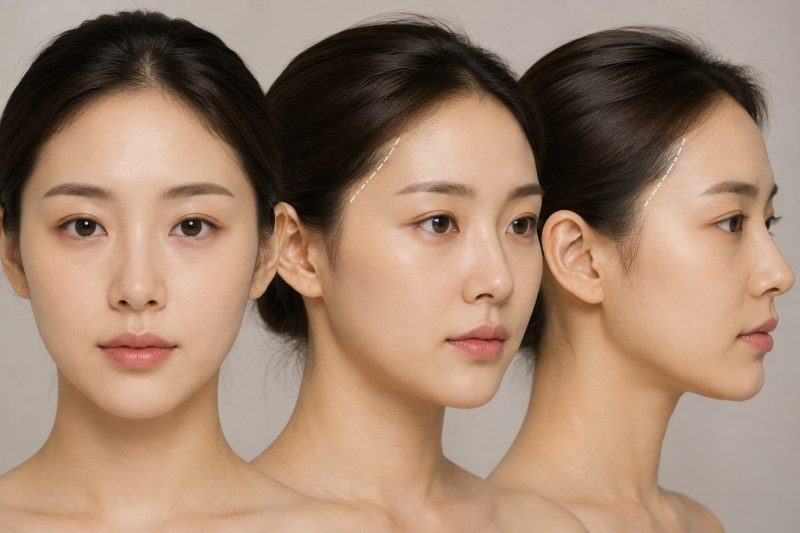
Which Face Types Need Temple Fillers? How Sunken Temples Affect Your Look
During consultations, we often hear concerns like these:
“My cheekbones look way too prominent.”
“Why does my face have this peanut-like shape?”
“I lost weight, and suddenly my face looks so much older.”
However, when we evaluate the facial structure closely, it often isn't that the zygoma (cheekbone) itself is excessively large, but rather that the area right above it—the temple—is sunken, making the cheekbone look relatively more projected.
In cases like this, temple filler can be considered.
Yet, having hollow temples doesn't mean blindly filling them up is always the right answer.
Because the temple area connects directly to the horizontal width of your face, adding excessive volume indiscriminately can actually make your face appear wider.
Therefore, when approaching temple filler, rather than looking at the hollow spot in isolation, it is crucial to assess how the facial contour transitions smoothly from the forehead down through the temples and into the lateral cheekbones.
Today, we will break down which face shapes benefit most from temple fillers, why hollow temples exaggerate cheekbone prominence, and what key factors you should evaluate prior to the procedure.
Why Do Temples Become Sunken?
Many patients remark that their temples used to look fine, but began hollowing out at some point.
Temple hollowing rarely stems from a single cause.
Everyone has a unique cranial and cheekbone structure, as well as differing amounts of soft tissue and temporal fat pads.
Some individuals naturally have slightly concave temples from the start, while others notice volume depletion as they age, causing hollows to look more pronounced than before.
Significant weight loss can also diminish facial fat volume, exaggerating the indentation around the temples.
Ultimately, sunken temples can result from a combination of innate skeletal anatomy, native soft tissue and fat distribution, age-related volume deflation, weight fluctuations, and natural bilateral skeletal asymmetries.
Crucially, what matters more than the absolute depth of the hollow is how the area harmonizes with the surrounding structures.
Even with slight concavity, if the transition between the cheekbones and forehead flows smoothly, it may hardly be noticeable.
Conversely, even if the hollowing is minimal, prominent lateral cheekbones right below can create an optical illusion of deeply sunken temples.
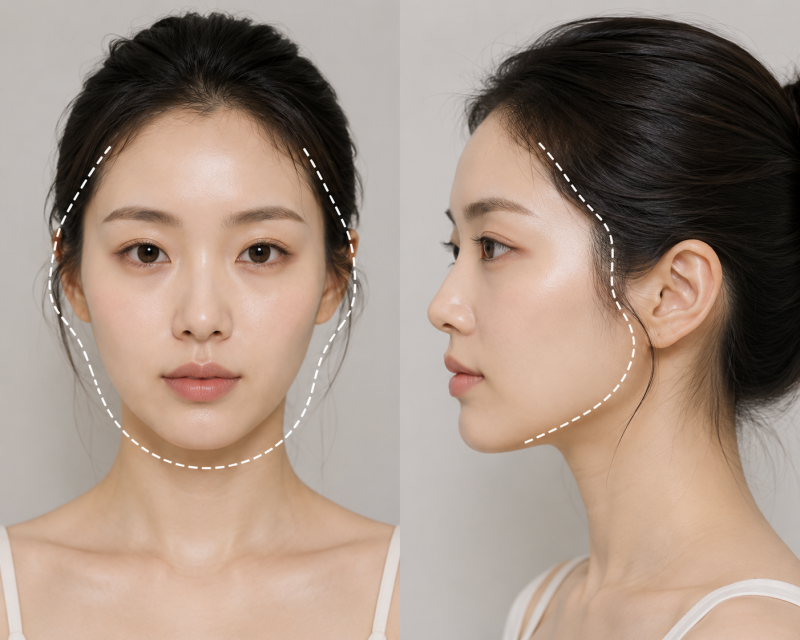
How Hollow Temples Impact Facial Expression
When the temples lose volume, the most immediate visual consequence is that the lateral cheekbones appear accentuated.
The cheekbones haven't suddenly grown larger; rather, the depression above creates a distinct step-off in height relative to neighboring zones.
Viewed from the front, the facial contour narrows inwards from the forehead into the temples, and then juts outwards again at the cheekbones.
The more pronounced this curvature is, the more likely the face takes on what is commonly termed a "peanut-shaped" outline.
Patients with hollow temples often feel that their cheekbones look overly protruding, that the midface looks wide, or that their outer facial silhouette looks angular and irregular instead of smooth.
Furthermore, even without losing weight, they can appear gaunt, chronically fatigued, or older than their years.
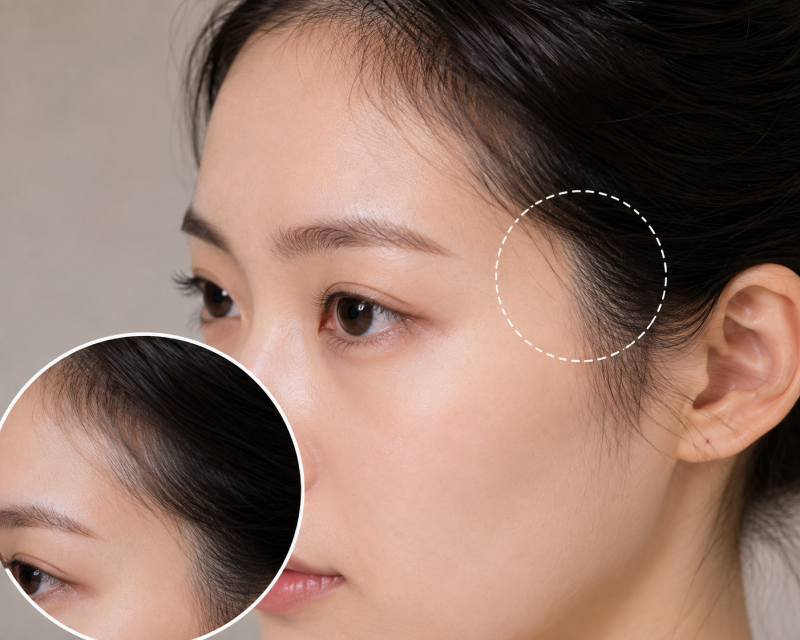
Temple concavities are often particularly conspicuous from a 45-degree angle rather than straight-on.
If photos taken from the front look fine, but oblique angles reveal deep shadows in the temporal area, it is worth examining whether sunken temples are disrupting your facial silhouette.

Face Profiles That Benefit from Temple Fillers
The most straightforward indication is noticeable concavity in the temporal fossa itself.
This occurs when the area leading down from the lateral forehead to the cheekbones is deeply recessed, casting dark shadows under various lighting angles.
In such cases, restoring missing volume to soften and reconnect the outer facial line is a logical approach.
Another common scenario is when the cheekbones appear excessively protruded.
It is important to remember that prominent-looking cheekbones aren't always a structural cheekbone problem.
When the temples above are indented, the lateral zygoma underneath inevitably looks more projected by contrast.
During a consultation, simply shielding the hollow temple area or visualizing a continuous contour often reveals that the cheekbones suddenly look much softer.
In these cases, blending and filling the deficient temple area alone can transform the entire facial harmony.
Some individuals have a beautifully rounded forehead, but experience an abrupt drop-off at the temples.
If the central forehead has ample volume but transitions into an immediate hollow laterally, the structural flow appears severed.
Here, rather than treating the temple as an isolated zone, the focus must be on creating a seamless continuity with the lateral border of the forehead.
Temple filler can also be considered for those troubled by a peanut-shaped face.
From the frontal view, repeated alternating curves—forehead width, temple depression, cheekbone projection, and buccal/cheek hollowing—create a bumpy, peanut-like contour.
If temple depression is a major contributor to this uneven outline, filler can be very effective.
However, a peanut-shaped face cannot always be corrected by temple filler alone.
If there is concurrent lower/lateral cheek hollowing, skeletal cheekbone width, or skin laxity, the underlying factors must be evaluated as a whole.
Another indication is sudden facial gauntness following weight reduction.
After diet or weight loss, the combined reduction of fat in both the temples and cheeks can cause the facial contours to turn sharply angular.
Patients frequently lament, "I lost the weight, but instead of looking better, my face just looks tired and aged." In such instances, assessing changes in the volume distribution across the temples and adjacent cheeks is essential.

Face Types That Require Caution with Temple Fillers
Conversely, just because the temples look slightly sunken does not mean fillers are automatically advisable.
If a person naturally has a broad facial width, adding excessive volume to the temples can make the face look even wider from the front.
For such facial structures, it is far better to subtly blend only the essential contours rather than attempting to make the depression completely flat or convex.
There are also cases where the true underlying cause is true skeletal cheekbone protrusion.
If prominent bone structure outweighs temple volume loss, merely filling the temples will rarely produce the refined shape the patient desires.
The same applies when significant skin laxity is present.
If an uneven facial contour is driven by sagging skin and descending soft tissues rather than a primary volume deficiency, relying on fillers alone is often an inappropriate strategy.
Additionally, if prior temple filler was performed, it is crucial to verify how much residual product remains.
Continuously topping up simply because it feels less filled than before can lead to unintended lateral expansion or unnatural bulges in the temporal region.

Can Filling Just the Temples Fix a Peanut-Shaped Face?
This is one of the most frequent questions encountered during consultations.
The short answer is: it varies from person to person.
A peanut-shaped face is rarely caused by temple hollowing alone; it is typically an interplay of temple depression, zygomatic arch prominence, lateral cheek hollowing, and overall facial fat distribution.
For instance, if the face features primarily hollow temples alongside relatively highlighted cheekbones, simply softening that transition with temple filler can make the entire contour noticeably sleeker.
Conversely, if severe lateral cheek hollowing or prominent cheekbone bone structure is the dominant feature, filling only the temples will yield minimal improvement.
Therefore, instead of assuming "peanut-shaped face equals temple filler," one must first pinpoint where the most disruptive curvature originates.

How Many CCs Are Needed for Temple Filler?
Patients often search online for "how many ccs of temple filler are needed?"
However, because the area, depth of concavity, and bilateral asymmetry vary dramatically across individuals, it is impossible to apply a standardized volume to every face.
Even with similar overall hollowing, scenarios differ: one side may be significantly deeper, the depression may spread broadly across both temples, volume might only be lacking at the forehead juncture, or a specific hollow might sit directly above the zygomatic arch.
Furthermore, because the temple defines the lateral periphery of the upper face, deciding *where* to limit the filler is far more critical than simply injecting a large amount.
The goal is never to overinflate the hollow into a bulge, but rather to design a subtle transition connecting the forehead smoothly to the cheekbones.
Rather than trying to match someone else's treatment volume, you should first identify the precise deficit and coverage required for your specific anatomy.

Why Is Precise Design Crucial for Temple Fillers?
While temple filler might look like a simple matter of filling a dent, it is in reality an intricate procedure that shapes the outer contour of the face.
Placing volume only on the inner aspect may fail to resolve the depression, while overfilling toward the outer margins can widen the facial silhouette.
This is why designing temple filler requires analyzing the continuous line flowing from the forehead, across the temples, and over the lateral cheekbones.
Moreover, human faces are naturally asymmetrical, meaning that injecting identical amounts on both sides is rarely the ideal choice.
If one temple is deeper or one cheekbone is broader, the required volume and placement depth must be adjusted accordingly.
Ultimately, what matters in temple filler is not how many ccs are injected, but where and in what shape the volume integrates with your anatomy.
How Long Does Temple Filler Last?
The longevity of temple filler depends on the specific product used, individual tissue characteristics, and the anatomical layer of injection.
Compared to high-mobility areas like the lips, the temples experience relatively little muscle movement, which often allows the volume to deplete at a slower pace.
Nonetheless, a single universal timeline cannot be applied to everyone.
Product formulations differ, and factors like previous treatments, injection depth, and total volume all influence how long the results are perceived to last.
Additionally, the passing of time does not automatically mean that prior filler has completely dissolved.
If you are considering a touch-up, rather than deciding based solely on elapsed months, it is best to first examine the existing residual volume and overall facial lines with a medical professional.

Post-Procedure Considerations
Immediately after a temple filler treatment, transient swelling, bruising, or tenderness from the injections can occur.
Because of this, the temples might look slightly more filled immediately post-treatment than they will once settled.
It is advisable not to judge the final volume right away, but to observe how the contour refines as swelling subsides.
That said, the temporal fossa houses critical vascular and nervous networks, demanding a high level of anatomical expertise and safety vigilance.
If you experience symptoms beyond mild swelling and tenderness—such as escalating severe pain, unusual skin discoloration or blanching, or visual disturbances including blurry vision, changes in visual acuity, or double vision—do not wait. Contact your treating medical clinic immediately for evaluation.
How to Avoid Regret with Temple Fillers
If you are contemplating temple filler, running through a few self-checks beforehand is highly recommended.
First, verify whether your primary aesthetic concern is truly caused by temple hollowing.
Feeling that your cheekbones are too prominent does not automatically mean temple filler is the proper solution.
Second, define the boundary of where the filling should stop.
The goal of temple filler is not to maximize volume, but to seamlessly connect broken facial lines.
Third, ensure you are not evaluating the temples in isolation.
The forehead, temples, lateral cheekbones, and adjacent lower cheeks must be assessed collectively to understand what element has the greatest visual impact on your facial shape.
Ultimately, achieving natural results comes from injecting only the amount required for overall harmony, rather than attempting to completely pack every hollow.

Frequently Asked Questions
Q. What facial profiles are suitable for temple filler?
A. It is suitable for faces where temporal hollowing disrupts the smooth line between the forehead and cheekbones, or causes the lateral cheekbones to look exaggerated. However, it is essential to rule out prominent bone structure or skin laxity as the primary cause.
Q. Do hollow temples make you look older?
A. Yes. Volume loss in the temples accentuates facial irregularities and casts deep shadows, which can impart a gaunt, tired, or aged look. However, overall impression is shaped by multiple balancing factors including the forehead, cheekbones, and cheeks.
Q. Can temple filler make cheekbones look less prominent?
A. In individuals where cheekbones appear emphasized due to adjacent temporal depression, smoothing that transition line can significantly soften the look of the cheekbones. However, it will not reduce the underlying skeletal structure of the bone itself.
Q. Does a peanut-shaped face always require temple filler?
A. Not necessarily. A peanut-shaped contour can be produced by a combination of hollow temples, prominent cheekbones, lateral cheek concavity, and fat distribution. Pinpointing the dominant cause is the critical first step.
Q. Can temple filler make the face look bigger?
A. Yes. If volume is excessively placed toward the outer periphery, the horizontal width of the face will appear broader from the front. This is why natural line blending between the forehead and cheekbones is essential, rather than overfilling the depression.
Q. Should both sides receive the same amount of filler?
A. Not always. Natural human faces exhibit structural asymmetries in both bone and soft tissue. The injection volume and positioning should be tailored to match each side's specific deficiency.
Q. How many ccs are typically recommended for temple filler?
A. There is no set standard. Volume must be determined based on the depth and area of depression, overall facial dimensions, forehead and cheekbone anatomy, and previous filler history. Copying someone else's treatment volume is ill-advised.
Q. Can the temples feel uneven or bumpy after filler?
A. Temporary irregularities can be felt due to post-injection swelling, product properties, or injection depth. If the unevenness persists or feels uncomfortable after settling, consult your treating clinic for an evaluation.
Q. Which post-treatment symptoms warrant an immediate call to the clinic?
A. If you experience severe or escalating pain, pale or mottled skin discoloration, or any visual anomalies such as blurring, diminished vision, or double vision, contact the medical clinic immediately for assessment.
Conclusion
It is difficult to define the ideal candidate for temple filler simply as someone with "sunken temples."
One must examine whether the hollow exaggerates the cheekbones, disrupts the transition between forehead and cheeks, or creates an irregular peanut-shaped facial line.
Conversely, if wide cheekbone bones, skin laxity, or buccal hollowing are the primary culprits, filling the temples alone will not achieve the desired aesthetic outcome.
Thus, what matters most with temple filler is not how much volume is added, but understanding precisely why the area looks sunken and designing a seamless, natural transition.
Be sure to assess your facial lines not only from the front, but also from the profile and 45-degree angles. Often, the ideal solution lies in the harmony of overall facial flow rather than treating the temple in isolation.
This article is provided for general informational purposes only; individual results may vary. Please consult a qualified medical professional for an accurate diagnosis and personalized treatment plan.
#TempleFiller #TempleFillerRecommendation #TempleFillerReview #TempleFillerBeforeAfter #TempleFillerEffects #SunkenTemples #HollowTempleFiller #PeanutShapedFace #PeanutFaceFiller #SinsaTempleFiller